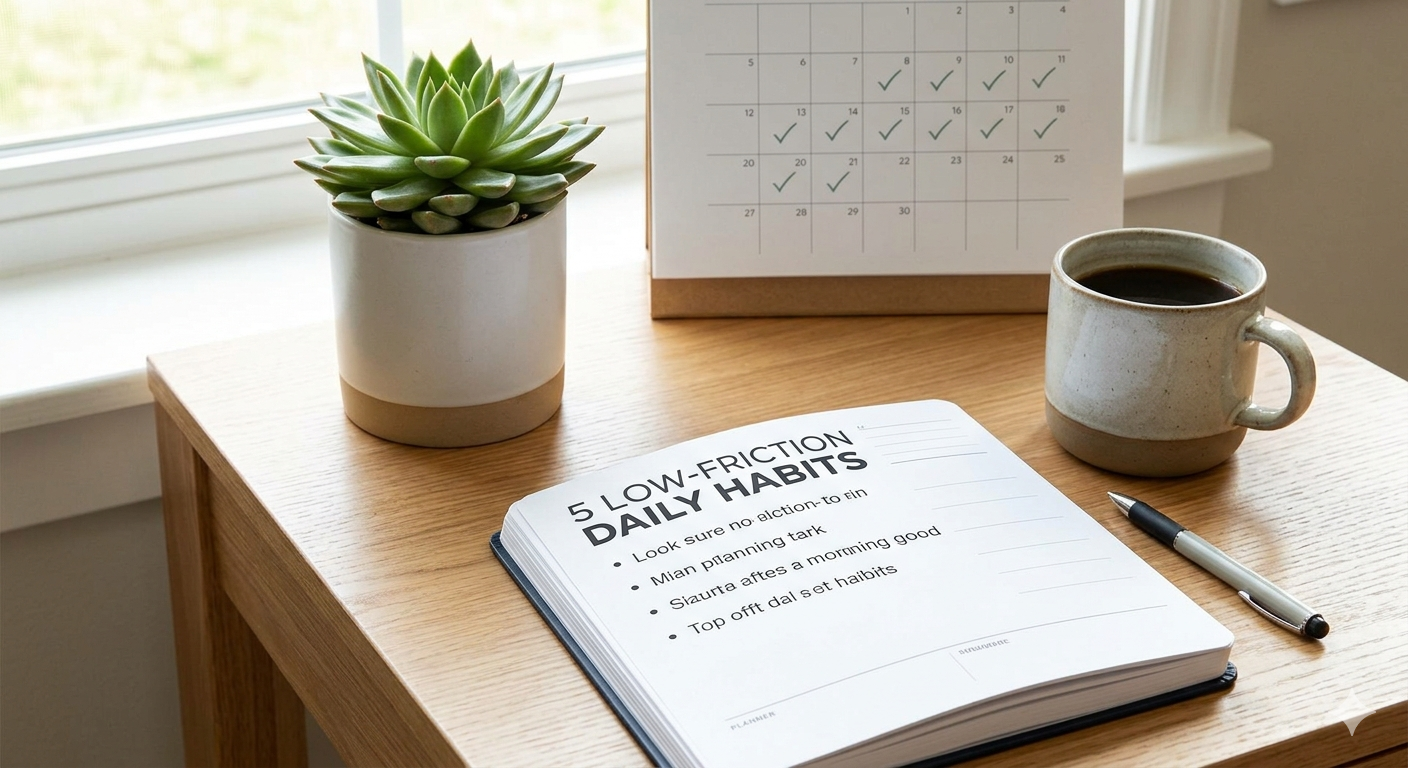
5 Low-Friction Daily Routine Habits for Beating Procrastination
Table of Contents
We have all been there: it’s 10:00 PM on a Sunday, and you’re feeling incredibly inspired. You map out the perfect, flawless daily routine for the upcoming week—complete with early wake-up calls, focused deep-work blocks, and zero distractions. You pull out a fresh notebook or open a blank document, determined that tomorrow will be the day everything changes. You map out a flawless, pristine schedule. It has a 5:00 AM wake-up call, an hour of intense exercise, a solid block of deep work before anyone else is even awake, and zero breaks. It looks beautiful on paper.
But by Wednesday afternoon, reality hits. The tasks pile up, exhaustion sets in, and you find yourself staring at a screen, mindlessly scrolling through notifications while putting off the one assignment that actually matters, feeling a heavy mix of guilt and frustration. If this cycle feels exhausting, I want you to take a deep breath and let go of the guilt.
It’s a frustrating cycle, but here is the cold truth: procrastination isn’t a lack of discipline, and it certainly isn’t laziness. It is not a lack of discipline, and it certainly doesn’t mean you are lazy. It is the natural, predictable consequence of designing high-friction schedules that fight against your brain’s natural energy levels. If you want to finally break the cycle of putting things off, you don’t need more willpower—you need a simpler blueprint.
When we try to force ourselves into rigid, overwhelming frameworks, our minds naturally rebel. If you want to finally break the cycle of putting things off, you don’t need to summon a superhuman amount of willpower. Today, we are going to explore how shifting your focus to low-friction daily routine habits can help you reclaim your focus, protect your mental energy, and build a day that feels genuinely sustainable.

The Hidden Psychology: Why We Really Stall
Before we look at the practical steps for building daily routine habits, we need to understand what happens when we procrastinate. For years, conventional productivity advice has told us that procrastination is a time-management problem. We are told to buy better planners, install stricter website blockers, or just “grind through it.”
But behavioral science tells a completely different story. Procrastination is not a time-management deficit; it is an emotional regulation problem.
When you look at a task on your to-do list and feel a sudden urge to clean your kitchen or check your phone instead, your brain is attempting a quick evolutionary hijack. The brain perceives the large, ambiguous task as a minor threat—an entity that might bring about feelings of boredom, self-doubt, confusion, or anxiety. To protect you from those uncomfortable feelings, your brain seeks immediate mood repair. It guides you toward an activity that offers an instant hit of dopamine with zero friction, like checking social media.
This is exactly why aggressive, multi-step schedules fail us. When we over-engineer our days, we inadvertently build a massive wall of psychological friction. If your schedule requires fifteen daily routine habits before breakfast, your brain views the entire morning as an emotional mountain to climb. The moment you feel slightly tired or overwhelmed, your mind defaults to the easiest path of escape.
True productivity isn’t about pushing yourself to the brink of burnout. It’s about designing low-friction daily routine habits that make starting so incredibly easy that your brain doesn’t have the chance to trigger its defense mechanisms. By lowering the barrier to entry, we can gently bypass the emotional resistance that causes us to stall in the first place.
1. The “Two-Minute Rule” for Execution
The hardest part of any task is almost always the act of beginning. Think about a project you’ve been avoiding. The thought of spending four hours analyzing data or writing a massive report feels incredibly daunting. The mental weight of that large block of time creates immense friction.
To beat this, we can utilize the Two-Minute Rule, a concept popularized by productivity expert David Allen and refined by James Clear. The rule states: When you start a new habit, it should take less than two minutes to do.
[ Massive, Intimidating Task ] ---> High Friction ---> Procrastination
               |
         Gently Scale Down
               v
[ The Two-Minute Micro-Step ]  ---> Low Friction  ---> Momentum
Of course, you cannot finish a major project or clean an entire house in two minutes. The goal here isn’t completion; it’s initiation. Once you start doing something, it is infinitely easier to keep doing it.
Here is how you can apply this to your daily routine habits:
- Instead of telling yourself, “I need to read one chapter of a book tonight,” your rule becomes: “I will open my book and read a single sentence.”
- Instead of saying, “I need to do a grueling 45-minute workout,” your micro-step is simply: “I will put on my running shoes and step outside.”
- Instead of framing a task as, “I have to write a 2,000-word blog post,” your baseline goal becomes: “I will open a blank document and write for two minutes.”
By scaling your goals down to a micro-step, you eliminate the emotional threat that triggers procrastination. You are telling your brain, “Look, we are only doing this for two minutes. It won’t hurt.” More often than not, once you have written that first sentence or spent two minutes at your desk, the momentum takes over, the friction melts away, and you find yourself continuing naturally. And on the rare days when you truly stop after two minutes? You still win, because you kept the habit alive and reinforced your consistency. With that, you are well on your way to building great daily routine habits!
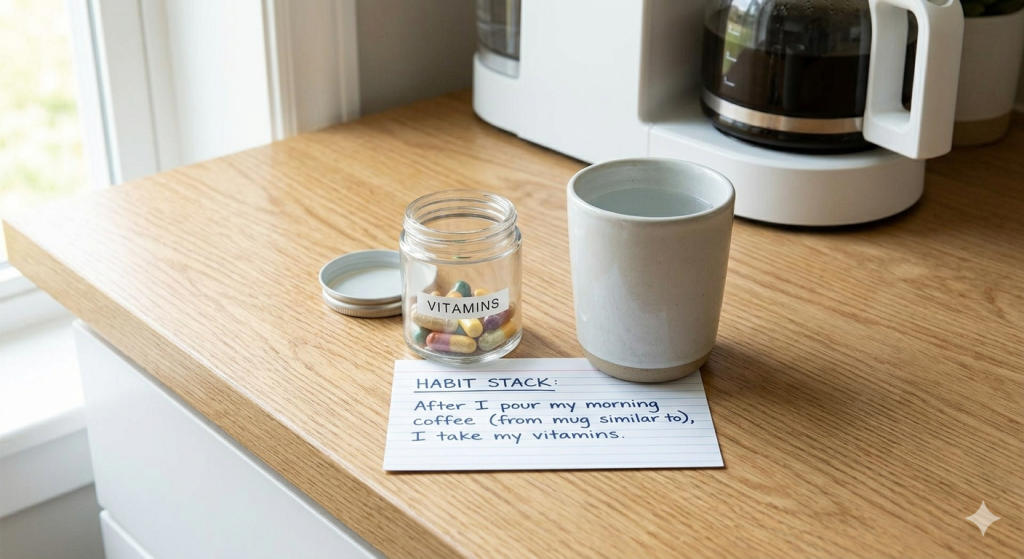
2. Anchoring with “Habit Stacking.”
One of the biggest mistakes we make when trying to upgrade our lives is trying to pull new behaviors out of thin air. We tell ourselves that we will start stretching every morning or tracking our expenses every evening, but we leave the “when” and “where” completely ambiguous. When the day gets busy, these unanchored intentions are the very first things we forget or put off.
Our brains build incredibly strong neural pathways for the things we do automatically every day—like brewing a morning coffee, brushing our teeth, or closing our laptops at the end of a workday. If you want a new behavior to stick, you shouldn’t try to rely on memory or willpower. Instead, you can “stack” your new intention directly on top of a well-established baseline, thus adding one to your daily routine habits.
The basic formula for this strategy is straightforward:
“After I [Current Established Habit], I will [New Low-Friction Habit].”
Let’s look at how this transforms the way we structure our daily routine habits:
- For Mindfulness: “After I pour my first morning cup of coffee, I will sit quietly and write down my top three priorities for the day.”
- For Health: “After I brush my teeth at night, I will immediately floss one tooth.”
- For Mental Clarity: “After I close my laptop to end the workday, I will immediately step away from my desk and stretch for five minutes.”
+-----------------------------------+
|  Established Habit (The Anchor)   |  --> e.g., Pouring morning coffee
+-----------------------------------+
                  |
         Flows Naturally Into
                  v
+-----------------------------------+
|    New Low-Friction Behavior      |  --> e.g., Setting 3 daily priorities
+-----------------------------------+
By anchoring your new choices to an existing anchor, you remove the friction of decision-making. You no longer have to ask yourself when you will do a task or wait for the “perfect” moment of inspiration. The existing habit acts as a natural cue, seamlessly pulling the new behavior along.
3. The Power of “Routine Minimalism.”
If you browse social media for productivity inspiration, you will quickly find highly aesthetic videos showcasing elaborate morning routines. They involve journals, extensive meditation sessions, intricate multi-step skin care steps, and complex meal preparations before the sun is even up. While these can be wonderful if they bring you joy, forcing yourself into an elaborate system can often create an unsustainable amount of pressure.
When a schedule requires a long sequence of perfect steps, it becomes incredibly fragile. If you wake up late, miss a step, or feel slightly under the weather, the entire system collapses. This failure often triggers an “all-or-nothing” mindset: “Well, I already ruined my perfect morning, so I might as well procrastinate for the rest of the day.”
To protect your focus, I highly recommend embracing routine minimalism. This means intentionally keeping your baseline requirements as simple and low-friction as possible.
Instead of aiming for a flawless fifteen-step morning, focus on protecting your core cognitive energy. Your minimalist routine might simply be: waking up, drinking a glass of water, and sitting down to tackle one important task before looking at your phone.
When your daily routine habits are streamlined and gentle, they become incredibly resilient. They can survive a poor night’s sleep, a chaotic morning, or a busy travel schedule. By stripping away the unnecessary complexity, you leave your brain with more energy to dedicate to the work that truly matters to you.
4. Designing a “Zero-Decision” Morning
Decision fatigue is a quiet productivity killer. Every single morning, from the very moment we open our eyes, our brains are forced to make a continuous stream of minor decisions: What should I wear? What should I eat for breakfast? Which email should I reply to first? Should I work on this project or check my calendar?
While these choices seem small individually, they draw from the exact same finite pool of mental energy that you need for deep focus and emotional regulation. By the time you sit down to do your actual work, your brain has already burned through a significant portion of its cognitive reserves. When faced with a complex task, a fatigued mind will almost always choose the path of least resistance: procrastination.
The secret to a focused morning is to eliminate as many decisions as possible before the day even begins. You can achieve this by setting up simple, pre-planned structures the night before:
| The Night Before | The Next Morning | The Low-Friction Benefit |
| Select your outfit and lay it out completely. | Get dressed immediately without thinking. | Saves 5 minutes of aimless closet browsing and decision fatigue. |
| Choose your single most important task and open the file on your screen. | Sit down and immediately begin working on that exact file. | Prevents you from opening your inbox and getting lost in reactive fire-fighting. |
| Decide what you will have for breakfast. | Prepare your food automatically. | Eliminates early morning kitchen friction and decision-making. |
When your morning choices are pre-made, you can transition from sleep to focused execution smoothly. You aren’t wasting precious mental energy negotiating with yourself about what to do next. Your day simply flows forward on a clear, pre-established track.
5. Evening Reflection: Shifting from Guilt to Assessment
How do you normally end a day where things didn’t go quite as planned? If you are like most people, you might close your laptop with a heavy sigh, look at your unfinished to-do list, and feel a wave of self-criticism. You promise yourself that tomorrow you will “try harder” and “be more disciplined,” carrying that lingering stress right into your evening.
Unfortunately, meeting procrastination with self-blame actually makes the problem worse. Because procrastination is rooted in negative emotions, beating yourself up simply increases the anxiety and pressure you feel surrounding your tasks. This heightened emotional tension makes you even more likely to put things off until the following day, and interrupt the process of your daily routine habits.
To break this loop, we need to replace self-criticism with a curious, objective assessment. At the end of the day, take just three minutes to look over your schedule, not as a harsh judge, but as an objective observer trying to optimize a system.
Ask yourself two simple questions:
- Where did I encounter the most friction today? (e.g., “I realized that when I tried to write right after lunch, I was way too tired and ended up scrolling on my phone.”)
- How can I lower the friction for that specific moment tomorrow? (e.g., “Tomorrow, instead of forcing deep work during my post-lunch energy slump, I will use that time to handle simple administrative tasks or take a short walk.”)
[ End of the Day ]
        |
        +---> Harsh Self-Criticism ---> Increased Anxiety ---> More Procrastination (The Loop)
        |
        +---> Curious Assessment ---> System Optimization ---> Smoother Flow Tomorrow (The Fix)
When you treat your stumbles as valuable data points rather than personal failures, your entire relationship with productivity changes. You realize that a broken routine isn’t a sign that you lack discipline—it’s simply an indication that a specific part of your system had too much friction. By gently tweaking your daily routine habits to accommodate your natural energy rhythms, you create a day that feels supportive rather than restrictive.
Bringing it All Together: A Gentle Reminder
As you begin to experiment with these ideas, please remember that the goal is never perfection. Life is inherently unpredictable. There will always be mornings when you sleep past your alarm, days when urgent requests derail your plans, and afternoons when your focus simply fades away. That should not stop you from your daily routine habits.
Consistency doesn’t mean never breaking your stride; it means having a simple, low-friction framework that makes it incredibly easy to step back onto the path when you do stray. A basic, realistic routine that you can maintain through a busy or stressful week is infinitely more powerful than a flawless, intensive schedule that you can only manage for three days before burning out.
Be gentle with yourself as you build these new pathways. Choose just one small habit or anchor to experiment with tomorrow. Focus on making the start as small and effortless as possible, protect your cognitive energy, and let momentum do the heavy lifting. You’ve got this.
Let’s Keep the Conversation Going
I would love to hear your thoughts on building daily routine habits. What is the single biggest roadblock or friction point that usually breaks your focus during the day? Let’s chat down in the comments below!
This editorial piece in The New York Times, written by Charlotte Lieberman, “Why You Procrastinate (It Has Nothing to Do With Willpower)” completely revolutionized the mainstream conversation around time management and daily routine habits. Instead of telling readers to “just try harder,” the editorial dives deep into the behavioral science, showing that procrastination is actually an emotional regulation problem, not a time-management deficit.
It argues that we put things off to avoid the immediate, uncomfortable feelings associated with a task—such as boredom, self-doubt, or anxiety. So what’s stopping you from building great daily routine habits?
Topics covered in this piece: daily routine habits, beat procrastination, habit stacking, two-minute rule, digital minimalism, brain wealth, productivity tips, daily habits for success, stop procrastinating, morning routine checklist, focus and productivity, sustainable habits, mindfulness routines, eliminate decision fatigue, prevent burnout.