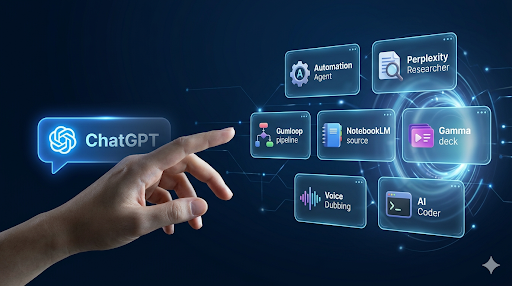

The Top 7 AI Workflow Tools 2026: Moving Beyond Simple Chatbots
Table of Contents
Introduction: From Chatbots to Autonomous Agents
March 2026. A quick check of your digital systems reveals an environment vastly different from the one we navigated just a few years ago. We remember 2023 and 2024 as the “years of the prompt.” The noise was overwhelming. Everyone was talking about how artificial intelligence would change everything, yet for many professionals, the reality was a barrage of new tabs, disjointed applications, and the persistent question: “How do I actually make this work for me?”
The initial wave of AI—the large language model chatbots like ChatGPT—was indeed revolutionary. They unlocked creativity and streamlined writing. But we quickly discovered the limitation. To use them, we had to stop what we were doing, open a separate interface, craft a detailed instruction, wait for an answer, and then manually copy-paste the result back into our primary application. We weren’t automating our workflow; we were managing an AI assistant. We were still the bottleneck.
If 2024 was about conversation, 2026 is about execution. The paradigm shift that defines professional productivity right now is the move from simple, reactive chatbots toward Agentic AI. Towards AI Workflow tools.
What does “agentic” mean in practice? An AI chatbot is designed to provide information. An AI agent is designed to achieve a goal. A chatbot answers “how do I research a market?” An AI agent conducts the market research, formats it into a report, and emails it to your team while you work on something else. This article will guide you through the seven tools—the specialized agents, logic processors, and creative engines—that are actively defining this new era of deep automation. These are the AI workflow tools 2026 must adopt to move beyond noise and into meaningful, sustainable productivity.

The Top 7 AI Workflow Tools 2026: Moving Beyond Simple Chatbots
The following list prioritizes tools that excel at moving information autonomously across multiple software platforms or that ground their generation strictly within your private data. While “all-in-one” AI features are becoming common within individual apps, the AI Workflow Tools here are selected for their ability to manage complex, multi-step, logic-based workflows that are critical for modern business and professional operations.
AI Workflow Tools – 1. Zapier Central: The Autonomous Brain Connecting Your Stack
For over a decade, Zapier has been the undisputed king of application programming interface (API) connectivity. Their core product used a linear logic: If this happens in App A, then perform that action in App B. It was effective, but rigid. If you wanted the system to handle a nuance, you had to manually build extremely complex, branching logic trees with conditional filters.
Zapier Central is the 2026 breakthrough AI Workflow Tools that integrates the intelligence of large language models (LLMs) with that massive ecosystem of over 6,000 application connections. Instead of mapping specific data points between apps, you “teach” a Central agent in plain language.
The Workflow Redefinition:
Imagine you receive a sales lead through a LinkedIn form.
- Old Zap (Pre-Agent): Form submitted -> Create record in Salesforce -> Send me a Slack message. (This is good, but basic).
- Zapier Central Agent: A single agent, trained on your product knowledge base, is listening. Lead comes in -> The agent autonomously visits the lead’s company website -> It reads their ‘About’ page to gather context -> It reviews their existing interaction history in your customer relationship management (CRM) software -> It then drafts a highly personalized, context-aware follow-up email in your tone and puts it into your email draft folder, while also updating the Salesforce record with the new intelligence it gathered.
Key Features for 2026:
- Dynamic Decision-Making: The agent can decide when to execute a multi-step workflow based on complex parameters, not just basic triggers.
- Persistent Context: It maintains a “memory” of past automated interactions across your entire software stack, ensuring automation doesn’t feel robotic.
This tool is critical for any business looking for AI automation for small business that scales without massive coding overhead. By placing a specialized, autonomous agent at the intersection of your tools, you are building an operation that logic-checks itself.
AI Workflow Tools – 2. Perplexity Pages: Search is Dead; Instant Intelligence Reports Are Born
The era of traditional search engines—spending hours clicking links, fighting through search engine optimization (SEO) spam, and summarizing different viewpoints—is effectively over for research-heavy professionals in 2026. Perplexity was the pioneer in generative answer engines, providing citations alongside immediate, consolidated answers and is one of the Top AI Workflow Tools.
However, its most transformative feature for modern workflows is “Pages.” While its main interface is brilliant for instant answers, Perplexity Pages is built for generating comprehensive, structured, and beautiful documentation from massive web data sets.
The Workflow Redefinition:
Research, whether for a competitive landscape, a complex scientific concept, or a regulatory update, used to be a discrete task that took hours or days.
- The New Workflow: You open Perplexity Pages and input a goal: “Create a comprehensive 10-page market intelligence report on the 2026 alternative battery landscape in the Pacific Northwest.”
- The Result: Perplexity’s autonomous agent reads the entirety of the live web on that topic. It verifies facts across multiple high-authority sources. It structure the resulting document with clear headers (H2s and H3s), generates data visualizations (charts) based on real statistics, and provides hundreds of linked citations for your verification.
Key Features for 2026:
- Deep Research Agents: For complex queries, Perplexity will now deploy iterative agents that perform search queries sequentially, learning from each result to refine the next query until a comprehensive data picture is built.
- Auto-Update Capabilities: A Page can be “subscribed to,” allowing the AI to update the report and its charts in real-time as new, relevant studies or news articles are published.
This transforms research from a production bottleneck into a powerful, automated intelligence feed. It is a fundamental AI Workflow Tools for anyone seeking a competitive, data-driven professional productivity advantage.

AI Workflow Tools – 3. NotebookLM (Google): Your Private, Hallucination-Free Subject Matter Expert
The single greatest point of friction in adopting AI for business has been trust. A foundational model (like GPT-4o or Gemini 1.5 Pro) “knows” the entire public internet, but it cannot know your business data. Attempting to get these models to analyze complex internal documentation often results in “hallucinations”—confidently made-up facts that make the technology too risky for high-stakes decisions.
Google’s NotebookLM solved this fundamental conflict by inventing the “source-grounded” workflow. It is not an “assistant” that happens to read your notes; it is a dedicated instance of an LLM whose primary instruction is to only answer using the documents you provide. NotebookLM is thus the 3rd entrant to the list of Top AI Workflow Tools.
The Workflow Redefinition:
Imagine you are starting a new, complex project involving fifty distinct sources: meeting transcripts, internal white papers, regulatory PDFs, messy spreadsheet data, and five relevant email chains.
- The NotebookLM Workflow: You create a “Notebook” and upload all fifty files. The AI immediately indexes them, creating a private knowledge base grounded in reality. You then simply ask your notebook. “What were the three key concerns the compliance team had in the October meeting?” The AI answers precisely, linking directly to the specific paragraph in the correct source document.
- The Content Redefinition: You can ask the agent to turn those fifty sources into a detailed FAQ list, a briefing document for your executive team, a detailed marketing roadmap, or even a personalized study guide.
Key Features for 2026:
- Audio Overview Integration: NotebookLM’s ability to generate a conversational, multi-host, podcast-style summary of your notes is now indispensable. Busy executives can listen to a detailed briefing of complex project data during their commute.
- Universal Input: In 2026, NotebookLM can ground its knowledge not just in documents, but also in live Google Sheets, specific web pages, and even verified data warehouses.
NotebookLM is the quiet engine powering deep professional workflows. It moves AI from “creative exploration” to “verifiable intelligence,” making it an essential NotebookLM for business use case.
AI Workflow Tools – 4. Gumloop: A Visual Canvas for Building Your Own AI Digital Workforce
For many professionals, there is a distinct productivity “gap.” They are non-technical but have automation ideas that are too complex for basic tools (like simple Zapier triggers) yet not massive enough to require hiring a full development team. This gap is being filled by “Visual Workflow builders” or “AI Orchestration Platforms,” and Gumloop is currently defining this space in 2026 as one of the best AI Workflow Tools.
Think of it as the digital equivalent of an industrial engineer building a manufacturing line. You don’t write code; you drag and drop modular “nodes” that perform single tasks (e.g., “Scrape Website,” “Translate with Claude,” “Generate Image,” “Send a Slack Message”) and connect them into a sophisticated pipeline.
The Workflow Redefinition:
Consider a complex task that typically requires a human assistant half a day: monitoring competitors.
- The Gumloop Workflow:
- Node 1 (Trigger): Runs every day at 8:00 AM.
- Node 2 (Scraper): Visits five competitor homepages.
- Node 3 (Summarizer – Model A): Uses GPT-4o to identify the main messaging changes.
- Node 4 (Summarizer – Model B): Uses Claude 3.5 Sonnet to analyze any pricing changes.
- Node 5 (Classifier): Determines if the changes are “High Alert” or “Information Only.”
- Node 6 (Output): If “High Alert,” send a detailed Slack to the senior team. Otherwise, add the summary to a shared Google Doc for the weekly review.
- The Impact: This “digital employee” runs autonomously, requiring no prompting and only flagging exceptions and is one useful AI Workflow Tools.
Key Features for 2026:
- Model Agnosticism: Crucially, you can use the best AI model for each specific step in the chain. Use Claude for nuance, GPT for speed, and specialized models for data classification—all in one visual flow.
- Dynamic Scraping Agents: Gumloop’s scrapers have evolved into mini-agents capable of handling complex visual data extraction, navigating logins, and interacting with interactive charts.
If you can describe your workflow logic, you can now build and deploy it as a dedicated, custom AI application, redefining professional productivity from the ground up.
AI Workflow Tools – 5. Gamma: Reimaging Presentation and Content Creation from the Ground Up
The traditional ways of presenting data—whether with PowerPoint slides designed in 2005 or overly formatted text documents—do not work in 2026. Our attention spans are fragmented, and our content must be responsive, interactive, and fast. Gamma is the tool that successfully applied the “agentic” shift to visual storytelling and they are the 5th entrant into my list of the Top AI Workflow Tools.
A simple prompt to Gamma doesn’t just generate some bullet points and suggest an image. It takes your high-level goal and autonomously builds a complete, cohesive, visually polished narrative structure that exists as a “living document”—a document that looks and behaves like a website but retains the structure of a presentation.
The Workflow Redefinition:
Creating a presentation used to mean choosing between being a graphic designer or a subject matter expert.
- Old Workflow (PowerPoint): Research the data -> Write the content -> Pick a template -> Spend 6 hours manually adjusting text boxes, resizing images, and fixing alignment.
- Gamma Workflow (March 2026): Type a single goal: “Create a cohesive 10-slide strategy deck for a seed funding round for my carbon-capture startup. Include the problem, solution, market size, and a financial summary node.”
- The Result: Gamma’s agent builds the structure, creates logical sections, drafts high-quality professional copy, finds appropriate visual assets (or generates them with its integrated image agent), and formats it all into a responsive, elegant deck. You can then refine the entire aesthetic with a single click.
Key Features for 2026:
- Nested Living Content: Gamma documents can now embed live dashboards (from Perplexity or Gumloop), interactive data nodes, 3D models, or even code interpreters, all within a clean, polished interface.
- AI-Driven Theme Control: The AI acts as your dedicated graphic designer. Instead of adjusting fonts, you tell Gamma: “Make this entire deck feel more approachable, optimistic, and green,” and the AI updates every visual parameter on every card instantly.
Gamma ensures that “visual creation” is no longer a bottleneck for strategic professionals. It is the definitive AI slide deck generator for the agentic era.
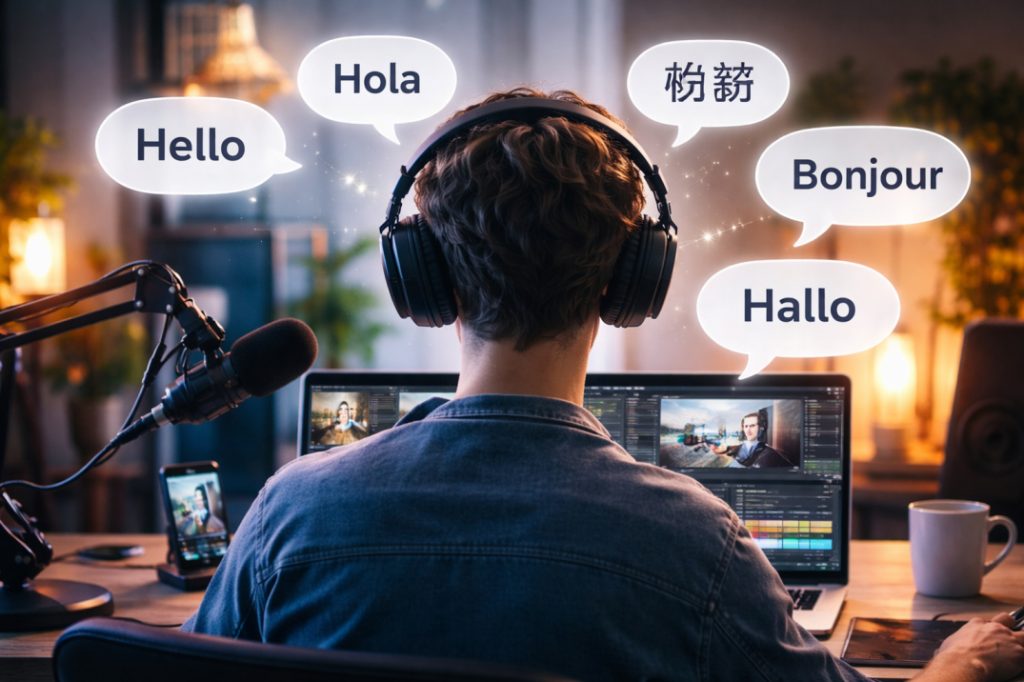
AI Workflow Tools – 6. ElevenLabs: Breaking Global Barriers with Instant Voice Dubbing and Synthesis
A true redefined workflow isn’t just about efficiency; it’s about exponential reach. In 2026, communication is video-first. We work, sell, and teach through audio and visual media. The barrier to reaching a global audience has always been language and authenticity. Traditional dubbing was slow, expensive, and impersonal.
ElevenLabs, renowned for its text-to-speech synthesis, has transcended that niche to become a critical communication agent. By March 2026, their product suite has redefined how businesses distribute knowledge. Thus, their product is part of my list of Top 7 AI Workflow Tools.
The Workflow Redefinition:
Imagine you are a small marketing agency producing a high-value product-explainer video.
- The New Global Workflow: You film the video once, in English, with your lead expert speaking naturally.
- The Agentic Step: You upload that video to ElevenLabs. Their autonomous dubbing agent isolates the voice signature, detects the exact emotional tone, and then instantly synthesizes a new audio track in Spanish, Japanese, German, Arabic, and 25+ other languages. Crucially, the Spanish version still sounds like your English expert, keeping their voice, accent, and natural cadence.
- The Productivity Impact: With its “Voice Isolator” (built into its 2026 workflow app), a creator can now instantly record clean audio anywhere (even with significant background noise) and then globalize that video, complete with lip-synchronization data, in minutes.
Key Features for 2026:
- Instant Dubbing and Lip Sync: The technology handles the entirety of the translation and localization stack, including generating the visual data needed to synthesize realistic lip movement for different languages.
- Emotional Voice Conversion: In 2026, you can ask ElevenLabs to keep the Spanish speaker’s identity but change their delivery to be “more energetic and urgent” for a sales presentation.
This tool transforms “reach” into an automated part of the creative pipeline, which is essential for defining the global multilingual content creation standard of 2026.

AI Workflow Tools – 7. Cursor & Lovable: The Convergence of Plain English and Powerful Software
The final barrier, and perhaps the highest, is software creation itself. We all have ideas for unique tools—a specific project tracker that fits our team, a dashboard that pulls just the correct data points, or a unique client portal. Until recently, you were limited to either using off-the-shelf software and compromising your needs or hiring expensive engineers.Now you can use these AI Workflow Tools.
March 2026 marks the dominance of “vibe coding”—the ability to build functional, professional-grade software simply by describing your requirements. While they address slightly different user technical levels, tools like Cursor (the premier AI-native code editor) and Lovable (a powerful, non-coder application builder) are defining this democratization of creation. More power to the AI Workflow Tools!
The Workflow Redefinition:
A non-technical project manager wants a simple, specific web application that uses GPT-4o to check meeting transcripts for compliance risks and flags them to a shared dashboard.
- Old Workflow: Impossible.
- Cursor/Lovable Workflow (March 2026): The manager simply speaks or types their requirement to the AI: “I want to build a internal tool with a login page. There should be an ‘Upload Transcript’ button. When a file is uploaded, use GPT-4o to check it for potential GDPR violations. If it finds one, create a card on a shared dashboard labeled ‘High Priority Review’ and include the offending text snippet. Make the dashboard look like a Kanban board.”
- The Autonomous Step: The AI agent writes all the code (the front-end interface, the back-end database, the API connections). It tests the code and automatically finds and fixes any bugs it generates. With one more click, the AI deploys the tool to a unique URL!
Key Features for 2026:
- Full-Stack Orchestration: The AI handles everything, including hosting, scaling, and managing the security parameters of your new app, allowing you to focus purely on the functional requirement.
- Live Collaborative Building: While the AI does the heavy lifting, you can interact with a live rendering of the app, giving feedback: “Move the dashboard button to the left,” or “Add a ‘resolved’ status to the cards.” The agent iterates instantly.
By allowing professionals to describe and then immediately use bespoke tools, Cursor and Lovable mark the final collapse of the “build versus buy” barrier, defining what it means to own your workflow stack.
Summary Table: The Right Agent for the Right Goal in 2026 – Top AI Workflow Tools
| If your primary goal is to… | Use this defining 2026 tool… |
| Create complex, autonomous logic that connects all your existing apps. | Zapier Central |
| Generate comprehensive, verifiable, and auto-updating intelligence reports. | Perplexity Pages |
| Interact privately and safely with your own verified internal documentation. | NotebookLM |
| Visually build multi-step AI pipelines and bespoke digital workers. | Gumloop |
| Turn high-level ideas into beautiful, responsive visual documents. | Gamma |
| Instantly globalize your audio and video communication with localized voice. | ElevenLabs |
| Create bespoke internal tools or web applications in plain English. | Cursor / Lovable |
Conclusion: Synthesize for True Productivity – AI Workflow Tools
March 2026 is not about finding “a better chatbot.” It is about understanding that professional productivity now requires moving from knowledge retrieval (talking to AI) to knowledge execution (deploying agents). While it is tempting to see these seven AI workflow tools as independent solutions, the true power lies in their synthesis.
True, redefining your workflow happens when these technologies are combined to form cohesive, multi-agent systems. Consider this scenario:
- Gumloop runs an autonomous daily scrape of your competitor’s price changes.
- It sends that unstructured data to NotebookLM, which analyzes the changes against your internal five-year strategy PDFs to generate a strategic impact brief.
- NotebookLM flags a potential “High Alert” scenario and, via Zapier Central, automatically creates a complex project in your CRM.
- Finally, Zapier Central prompts Gamma to generate the rough draft of the internal briefing deck for your leadership team, which is ready for your review before your first cup of coffee.
This isn’t science fiction. This is the definition of professional competence right now. The barrier to entry for this level of deep automation is no longer coding skill or massive budgets; it is purely strategic imagination—the ability to look at your daily, high-friction bottlenecks and ask, “Which agent can handle this goal for me?” “Which of these AI Workflow Tools will work best for me?”
The era of noise is closing. The era of agency is here.
Thank you for reading. We invite you to begin exploring all the AI Workflow Tools – the new standard of efficiency. Have you deployed any agentic AI into your operations yet? I would be curious and eager to hear about your primary workflow tools in 2026 in the comments below.